La vita è bella. L'inglese è esasperante.
English is such a silly thing. It has a host of weird features, including
- do-support ("Do you like enchiladas?"),
- idiosyncratic spelling (sugar, debris, tough, etc.), and
- contrastive stress (record vs. record)
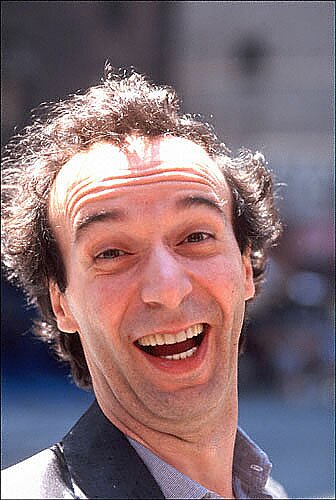
which, by objective standards, make it the Roberto Benigni of the cross-linguistic Oscars. And now, thanks to some fortuitous accidents of history, the whole world has to deal with its eccentricity. Imagine if a more predictable language like Swahili or Spanish were the lingua franca of the world! Billions of dollars saved on education and Wite-Out alone. Anyway, I can understand why some characteristics of English either mystify or escape people here--students and adults alike. Why, for instance, does "thirteen" sound almost exactly like "thirty?" Why do we pronounce "excuse" differently as a noun vs. as a verb? The other day, during a free period at the main junior high I teach at, I opened the "Dictionary of Contemporary English Usage" that was on the desk they gave me and found some whoppers.
- Why do we say "God save the King"? Shouldn't it be "God saves the King," or at least "God, save the King"?
- "I had a best suit that lasted me six years." Why not "the best suit," since there was only one?
- "More bad than useful," and "worse than useful" don't mean the same thing?
Not to mention the irksome presence of dental consonants (
three,
other), the Linux of fricatives. This language was invented by a Rubik's Cube. My dad is fond of a joke in this vein. When he's asked "How do you do?" he likes to answer, "How do I do what?"
Encore des pensées sur l'anglais. Je feuilletais un "Dictionnaire d'usage d'anglais contemporaire"
et j'ai trouvé cettes curiosités:
- Pourquoi dit-on "God save the King," au lieu de "God saves the King," ou "God, save the King"?
- Pourquoi dit-on "I had a best suit that lasted me six years," au lieu de "I had the best suit"? et,
- Pourquoi "more bad than useful" et "worse than useful" ne sont-ils pas interchangeables, puisque d'habitude "plus mauvais" devient "pire"?
Je vois pourquoi les adultes comme les enfants ici trouvent les exceptions de l'anglais très frustrantes. De ses consonnes fricatives (le son de "th") jusqu'à son orthographe sans règles, c'est une langue exaspérante. Dans ce sens, il est dommage que, grâce à quelques accidents de l'histoire, l'anglais soit devenu langue globale. Si une langue plus simple à apprendre, comme le swahili ou l'espagnol avait pris sa place, l'éducation de langue étrangère serait beaucoup moins compliquée, voir coûteuse.


 Posts
Posts


Hi Haithem I'm your uncle Ridha Amri from Paris Your daddy send your blog adress ..! C'est formidable ce que tu as fait jusqu'à présent..! (go ahead and good luck..) Dora est en Allemagne pour un stage de sept à huit mois..dés qu'elle sera de retour elle m'aidera pour créer un blog et pour communiquer facilement..
ReplyDeletehahaha, the linux of fricatives.
ReplyDeleteI remember having a teacher in JHS that said fish could just as well be spelled "ghoti" using our ridiculous pronunciation. I also wanted to tell you that I'm trying to teach myself french and reading your blog helps a bunch, I scroll down and read the french then go back up to the english lol
ReplyDelete